


In the field of ultrafast laser material processing, extreme control of processing scale has always been one of the core challenges in the field. With the in-depth development of nanoscale laser processing technology, the intrinsic limit problem of laser processing has become a frontier topic of concern in the academic community. Considering the laser focal spot limitation caused by the diffraction effect, the key to achieving super-diffraction nanoprocessing is to use laser-induced self-assembled scatterers to convert laser far-field radiation into near-field components. Therefore, regulating the behavior of lasers in the far field and near field is not only expected to break through the traditional optical diffraction limit and achieve nanoscale ultrafast material modification, but also to achieve an unprecedented resolution of several nanometers, opening up a new path for optical means to achieve atomic-level processing accuracy.
In the paper "Ultrafast Laser High Aspect Ratio Extreme Nanostructure Processing of Glass Materials Beyond λ/100" to be published in Ultrafast Science, a joint team of Professor Cheng Guanghua from Northwestern Polytechnical University and Researcher Razvan Stoian from Hubert Curien Laboratory of the French National Center for Scientific Research reported a breakthrough laser processing technology - the processing feature size can be lower than 1/100 of the wavelength of near-infrared ultrafast lasers, reaching the nanometer level, and can maintain this feature size in the depth direction of tens of microns. This technology uses a non-tightly focused long-focus deep non-diffraction beam to induce near-field nanoscale material ablation, thereby establishing a nanoscale material cutting mechanism. This ultrafast laser extreme nanoprocessing technology has diversified application prospects in two-dimensional and three-dimensional levels, covering multiple fields such as photonics, quantum information, sensing technology and even biomedicine.
The relevant research results were recently published in the Science Partner Journal Ultrafast Science under the title "Ultrafast Laser High-Aspect-Ratio Extreme Nanostructuring of Glass beyond λ/100".
The principle schematic diagram of non-diffraction ultrafast Bessel beam direct writing nanoporous structure scatterers and nanowires with a line width of 10nm on quartz glass is shown in Figure 1. The hollow nanostructure induced by a single-pulse non-diffraction ultrafast Bessel beam has a high refractive index gradient, which can produce strong scattering of the ultrafast laser field. Its near field contains two major components: a near-field surface component and an internal near-field component with similar distribution characteristics. In the direction perpendicular to the laser polarization, the near-field intensity distribution shows a field enhancement feature of better than 50%. However, in the direction parallel to the laser polarization, the near-field intensity distribution shows a significant attenuation, which effectively suppresses the laser-matter interaction in this direction. This asymmetric near-field distribution feature will be further enhanced during the scanning process of the laser pulse sequence, and through continuous evolution, it will promote the extension of the pore structure in the direction perpendicular to the laser polarization. Therefore, this mechanism shows the feasibility of extreme nanoscale processing through weakly converged large focal spots.

Figure 1: (a) Cross-section of a typical nanopore induced in fused silica by a weakly converged single-pulse non-diffracting Gauss-Bessel beam. These pore structures can extend to the back surface of the sample. This pore structure can be induced under a relatively wide range of cone angles, pulse widths and laser wavelengths. This nanodeep hole will produce a significant near-field modulation of the incident laser field, so that the field intensity in the area adjacent to the nanohole is significantly increased in the direction perpendicular to the laser polarization, and this feature always exists along the depth direction of the nanohole. (b) Using an ultrafast laser with a wavelength of 1030nm and a pulse width of 2ps and a repetition rate of 333kHz, a nanowire with a width of about 15nm was written at a speed of 1.2mm/s.
In order to study the processing mechanism of extreme-scale nanogrooves under the action of multiple pulses, this work constructed a multi-physics field model under the cumulative action of multiple pulses. Thus, the energy deposition and heat conversion process when different timing pulses act on the material during the focus movement process are analyzed. From the nonlinear laser energy deposition distribution, it can be obtained that in the near-field enhancement region induced by pore structure scattering, the local temperature induced by laser energy deposition can reach more than 3000K, which is enough to induce a phenomenon similar to laser surface ablation on the inner wall of the nano-deep hole. As a result, when multiple pulses accumulate, the locally enhanced near-field front continuously erodes the inner wall of the nano-deep hole, thereby forming a nano-deep groove structure. During the nanogroove processing process, the groove width shows a trend of decreasing with the increase of the deposition pulse line density. Since the ablation and expansion of the nanogroove mainly originates from the forefront of the enhanced near field, which has a higher spatial localization, the width of the nanogroove written by the ultrafast laser can even be smaller than the diameter of the starting pore structure scatterer.
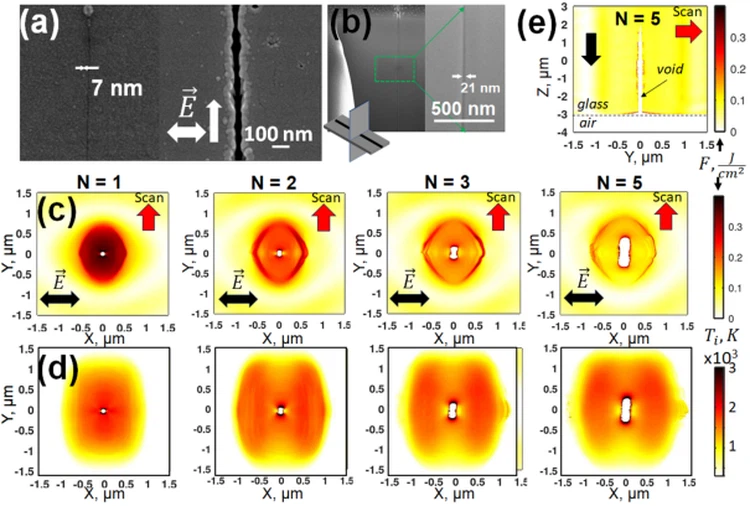
Figure 2: (a) Surface and (b) depth cross-section scanning electron micrographs of the nanogroove written by the ultrafast laser on the back surface of the sample. When the laser focus moves perpendicular to the laser polarization direction, the (c) nonlinear laser flux and (d) temperature distribution of the back surface of the sample acted on by different time pulses. (e) Nonlinear laser flux distribution on the depth cross section when the ultrafast laser acts on the nano-deep hole.


